The tiny home movement continues to captivate the imagination, reshaping how people think about housing, freedom, and the very definition of “home.” As more individuals trade large, traditional houses for minimalist and sustainable living, a whole new vocabulary has emerged. Terms like park model homes, tiny houses on wheels, and mobile micro homes are often used interchangeably, creating a cloud of confusion for aspiring tiny dwellers.
So, what’s the difference between a tiny home and an RV? And what is a park model tiny home, anyway? One is a house, and the other is a vehicle, right? The answer is a fascinating blend of both.
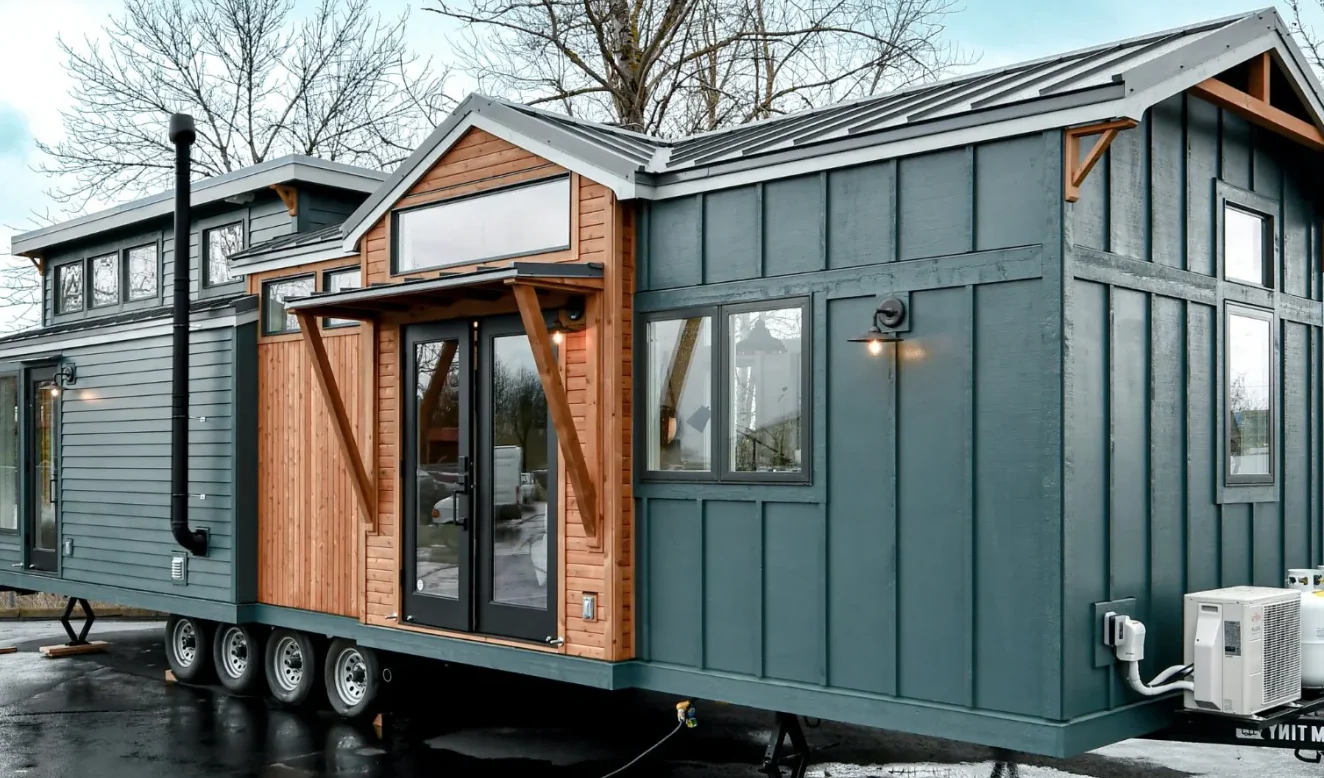
Recently, we’ve discovered that many tiny home enthusiasts are just now discovering a little secret that offers the perfect solution. It is possible to have the best of both worlds: the quality, style, and residential feel of a custom tiny home combined with the legal classification and convenience of an RV. At 400 square feet or less (excluding lofts), park model tiny home RVs create stunning, livable options. From open, spacious floor plans to lofted one-, two-, or even three-bedroom designs, they give homeowners exactly what they need for a wide range of lifestyles and budgets.
This guide will demystify the topic completely. We’ll break down the key differences, explain the crucial building codes, and show you why a certified park model tiny home might be the smartest, safest, and most beautiful path to your tiny living dream.
The Big Question: What’s The Difference Between A Tiny Home And A Park Model?
To understand what a park model tiny home is, we first need to clearly define the different types of tiny dwellings. A “tiny home” is a broad term, and its legal meaning depends entirely on how it’s built and how it’s intended to be used.
Type 1: The Tiny House on Wheels (THOW)
This is the iconic image of the tiny home movement. A THOW is built on a trailer chassis, designed for mobility, and typically under 400 square feet.
- Legal Status: In most places, a THOW is legally classified as a Recreational Vehicle (RV). However, many are built by DIYers or small-scale builders and may not adhere to any official building standard, which can create major legal and safety issues.
- Best For: Those who prioritize mobility and a nomadic lifestyle.
- The Challenge: Uncertified THOWs can be very difficult to insure, finance, or legally place in RV parks or tiny home communities.
Type 2: The Foundation-Based Tiny Home
This is a small home built on a permanent foundation, just like a traditional house.
- Legal Status: It is treated as a real property asset or an Accessory Dwelling Unit (ADU). It must be built to local residential building codes, often following the International Residential Code (IRC), specifically Appendix Q for tiny houses.
- Best For: A long-term investment on land you own, as it can appreciate in value.
- The Challenge: It must comply with local zoning laws, including minimum square footage requirements, which can make it illegal to build a primary dwelling under a certain size (e.g., 800 sq. ft.) in many areas.
Pro Tip: No matter what you build, always be sure to do the research in your local area to determine what your options are!
A Deeper Dive: What Qualifies as a Park Model?
So, where do park model homes fit in? While they are small-scale dwellings that appeal to the same minimalist lifestyle, their legal classification and intended use set them apart.
A Park Model RV (PMRV) is a unique type of recreational vehicle that is designed for seasonal or semi-permanent use, typically placed in RV parks or campgrounds. Although it looks and feels like a small home, it is legally an RV.
To qualify as a Park Model, a home must be:
- Built to ANSI A119.5 Standards: This is the strict building code for Park Model RVs, covering everything from plumbing and electrical systems to structural safety and fire prevention.
- No more than 400 square feet of living space on the main floor (this rule is why lofts are so popular, as they don’t count toward this limit).
- Built on a single chassis with wheels.
- Certified by the RVIA: It must carry a seal from the RV Industry Association (RVIA), proving it meets the ANSI code. This seal is crucial for legal recognition.
Why Not Just Get a Standard Park Model RV?
You might see traditional Park Model RVs for sale at large dealerships. While they meet the code, they are often mass-produced with lower-end finishes, less insulation, and a design that feels more like a camper than a home. They are not typically intended for full-time, four-season living.
This is where the Park Model Tiny Home comes in. It’s a custom-built tiny home that delivers high-end residential quality, but is engineered and certified to meet the legal standards of a Park Model RV.
The “Best of Both Worlds”: Why Park Models Can Be the Perfect Tiny Homes
Choosing a professionally built park model tiny home on wheels offers the perfect balance between modern living, design freedom, and legal compliance.
Unlike many DIY tiny houses that may not meet any safety standards, a certified park model tiny home is built to the rigorous ANSI A119.5 code. This ensures top-notch quality and, most importantly, makes it legally welcome in a vast number of RV parks and tiny home communities across the country.
Because they are officially classified and certified as RVs, park model tiny homes are often far easier to finance and insure than unregulated THOWs. Their semi-permanent design makes them a great fit for seasonal living, vacation rentals, or a primary residence in scenic areas—especially where zoning restrictions make it difficult to place a foundation-based home.
Can You Live In A Tiny Home Park Model RV Full Time?
This is the million-dollar question, and the enthusiastic answer from countless owners is YES!
While PMRVs were originally intended for seasonal use, a high-quality, custom-built park model tiny home is engineered for comfortable, full-time living. Working with a qualified builder gives you the opportunity to select best-in-class materials that you wouldn’t find in a standard RV, such as:
- High-performance, closed-cell spray foam insulation for four-season climates.
- Designer tile, quality lumber, and engineered hardwood flooring.
- Energy-efficient, residential-style appliances.
- Space-saving custom storage solutions and cabinetry.
With intentional design where every corner and cupboard has a purpose, minimalist living can be both beautiful and highly beneficial.
A Showcase of Possibilities: Park Model Tiny Homes by SVOLTEX
Now that we’ve explored the details, let’s take a look at what’s truly possible. Whether you’re an individual, a couple, or a growing family, the park model tiny home offers unmatched space, comfort, and design flexibility. With decades of experience, builders like SVOLTEX make it easy to customize a model that fits your lifestyle, budget, and aesthetic.
Park Model Tiny Home: The Villa Max
The Villa Max by SVOLTEX is a classic—a 10-foot-wide, 480-square-foot luxury park model designed in a modern farmhouse style. This spacious model includes:
- A full downstairs bedroom, an oversized loft, and a large 4.5′ x 8′ bathroom.
- A high-end kitchen with a 3-burner Furrion range, 24-inch apron-front sink, and a moveable island.
- Smart storage solutions like upper cabinets and storage stairs with a built-in washer/dryer combo.
- Luxury finishes including custom cabinetry, large windows, a residential mini-split HVAC system, and a backlit bathroom mirror.
Park Model Tiny Home: The Urban Park Max
The Urban Park Max from SVOLTEX is a 37’ x 10’ park model that proves luxury and cold-climate readiness can go hand in hand. Delivered to a client in Wyoming, this custom build is designed for harsh winters with:
- Closed-cell spray foam insulation and reinforced roof beams for heavy snow loads.
- An electric fireplace in the main-floor bedroom and a rough-in for a wood stove.
- A stunning interior with engineered hardwood, modern black slab cabinetry, and a freestanding soaking tub in the bathroom.
- High-efficiency systems like an on-demand water heater and a vented washer/dryer combo.
Park Model Tiny Home: The Cascade Max
The Cascade Max by SVOLTEX stands out with its clean, architectural design and a layout that maximizes every inch. Built just under 400 square feet, this model features:
- Oversized windows and high ceilings that flood the space with natural light.
- A clever walk-through bathroom design that allows for a full-size soaking tub without wasting square footage.
- A large pantry, poplar cabinetry, and modern appliances.
- A convertible Murphy bed at the back of the home that doubles as a flexible office space.
Park Model Tiny Home: The Urban Park Studio
Meet the Urban Park Studio from SVOLTEX—a sleek, compact park model designed for efficiency and style. At 18′ x 11′, this modern studio offers:
- A surprisingly spacious layout with a full bathroom, well-equipped kitchenette, and an electric fireplace.
- 140 cubic feet of built-in cabinetry and a pull-out dining table.
- An upstairs loft with a higher-than-average ceiling for added comfort and storage.
- Bold exterior styling with black cedar siding and copper lighting.
Conclusion: The Smart, Legal, and Livable Solution
So, can a park model be a tiny home? Absolutely. In fact, for many people, the certified park model tiny home RV is the perfect solution. It combines the legal recognition, financing options, and placement ease of an RV with the high-quality construction, residential amenities, and custom design of a luxury tiny home.
It offers a smart, legal, and beautiful path for today’s minimalist lifestyle, proving that you don’t have to sacrifice style or comfort to live tiny.